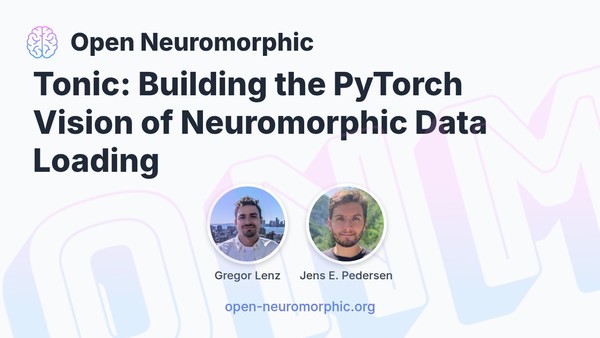
Unlike standard computer vision datasets with static image frames, neuromorphic systems generate dynamic, event-based streams that require specialized handling. Tonic bridges this tooling gap by providing a PyTorch-compatible interface designed specifically for event-based data, allowing researchers to load, transform, and batch neuromorphic datasets without building custom, slow data-loading pipelines from scratch.
Key Takeaways
- Tonic standardizes neuromorphic datasets into structured NumPy arrays, eliminating the need for fragmented, custom data loaders.
- The library applies transformations and augmentations directly to raw events, seamlessly converting them into image-like tensors for GPU processing.
- Parallel data loading and intermediate caching mechanisms ensure that data retrieval and transformation do not bottleneck GPU training speeds.
- Tonic supports multimodal datasets and integrates directly with the PyTorch ecosystem, accelerating event-based vision model development.
Workshop Format & Takeaways
The workshop centered on practical data handling workflows, contrasting the fragmented landscape of raw event formats (ROS bags, DAT files) with Tonic’s unified standard.
By applying a sequence of transformations, users can convert raw microsecond-resolution events into dense formats suitable for standard CNNs or SNNs—such as voxel grids, time surfaces, or 2D histograms. The session demonstrated live code configurations showing how researchers can chain Tonic transformations directly with standard torchvision augmentations (like random cropping) in just a few lines of Python.
A critical takeaway involved dataset slicing and caching. Because neuromorphic data acts as a continuous stream rather than discrete frames, slicing long recordings into accurate temporal windows introduces significant overhead. As demonstrated, caching intermediate transformed structures dramatically reduces per-epoch data loading times, ensuring the GPU remains fully utilized during training.
What This Means for Neuromorphic Computing
Standardizing data loading eliminates a major friction point in neuromorphic research. By providing a unified API akin to TorchVision, Tonic significantly lowers the barrier to entry for conventional machine learning practitioners exploring event-based vision, and paves the way for aggregating large-scale, multimodal datasets required to train robust foundation models.
Resources
- Learn more about Tonic at the Tonic software page.
About the Speakers

Gregor Lenz

Jens E. Pedersen
Upcoming Workshops
No workshops are currently scheduled. Check back soon for new events!
Are you an expert in a neuromorphic topic? We invite you to share your knowledge with our community.
Inspired? Share your work.
Share your expertise with the community by speaking at a workshop, student talk, or hacking hour. It’s a great way to get feedback and help others learn.