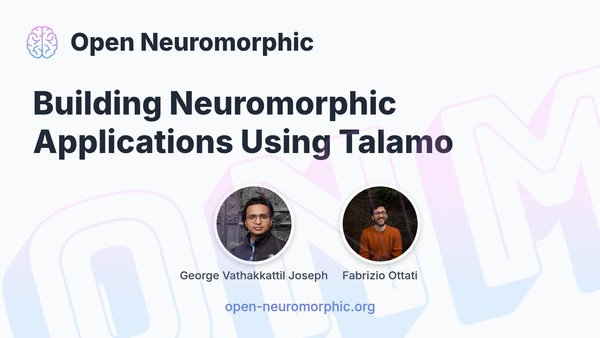
George Vathakkattil Joseph, Product Architect at Innatera, breaks down the Talamo SDK—a software stack designed to bridge the gap between spiking neural network (SNN) development and deployment on mixed-signal neuromorphic hardware. The session covers how developers can transition from standard PyTorch environments to fully optimized edge AI pipelines operating close to the sensor.
Key Takeaways
- Innatera’s mixed-signal spiking processors target sub-milliwatt, close-to-sensor processing for time-series data.
- The Talamo SDK enables end-to-end deployment, integrating custom PyTorch pipelines with hardware compilation.
- Analog computing benefits are amplified by SNNs, combining high dynamic range with digital robustness.
Workshop Format & Takeaways
The session featured a combination of architectural overview and a live code demonstration. The demonstration walked through building an audio scene classification pipeline (using the DCASE 2020 dataset) from scratch. It showcased how Talamo allows developers to define feature extraction (like MFCC using librosa), spiking encoding, and network training within a unified Python environment.
The pipeline integrates standard PyTorch capabilities with custom neuromorphic mapping. Finally, developers can seamlessly target a hardware simulator for evaluation before moving directly to silicon. This software bridge enables the optimization of continuous-time sensing data without forcing developers to abandon their familiar machine learning tooling or rewrite custom training loops.
What This Means for the Field
A major bottleneck in the adoption of neuromorphic hardware has been the lack of mature, accessible software toolchains. The development of SDKs that seamlessly integrate with standard machine learning operations (MLOps) tools like DVC and TensorBoard, while still exposing the low-level configurability of mixed-signal hardware, is a critical step toward commercialization.
It lowers the barrier to entry, allowing standard embedded AI engineers to leverage the power benefits of spiking networks without needing a PhD in neuromorphic engineering. Furthermore, Innatera’s focus on ultra-low-power edge nodes (sub-milliwatt budgets) points toward a future where “always-on” smart sensors can process audio and radar data instantly, without draining a battery or relying on external cloud computation. By marrying the dynamic range and efficiency of analog computing with the precision and robustness of digital systems via SNNs, developers unlock highly optimized pipelines specifically tailored for temporal, real-world data streams.
“The benefits of SNN really shine when you can do them as analog. You have all the power benefits and dynamic range benefits that come from analog, but also the precision and robustness of digital by having SNNs.” — as discussed in the workshop.
“Programmability is the single issue that is maybe holding us back… it’s not that neuromorphic computing cannot go mainstream now, it’s the programmability solution that really needs addressing.” — as discussed in the workshop.
About the Speakers

George Vathakkattil Joseph

Fabrizio Ottati
Upcoming Workshops
No workshops are currently scheduled. Check back soon for new events!
Are you an expert in a neuromorphic topic? We invite you to share your knowledge with our community.
Inspired? Share your work.
Share your expertise with the community by speaking at a workshop, student talk, or hacking hour. It’s a great way to get feedback and help others learn.