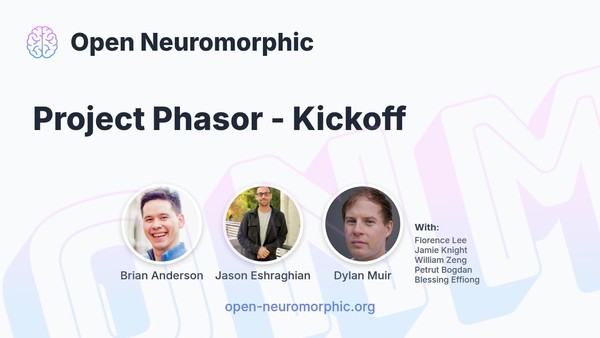
Project Phasor was launched to address critical inefficiencies within the neuromorphic and NeuroAI ecosystem, targeting the disconnect between academic novelty and commercial sustainability. By organizing community efforts around shared compilation tools, virtual machines, and open datasets, the initiative aims to build the foundational infrastructure required to scale neuromorphic workloads out of Edge inference and into data center-scale training.
Key Takeaways
- Project Phasor aims to build a shared, production-quality neuromorphic compiler optimized for heterogeneous compute integration.
- The initiative prioritizes an open library of behavioral virtual machines to decouple hardware exploration from physical chip dependencies.
- Creating standardized, open-source neuromorphic datasets is critical to replacing converted RGB data and enabling rigorous benchmarking.
- A compiler-first mentality ensures higher-level frameworks have a stable, standardized foundation for deploying large-scale models.
Workshop Format & Takeaways
The kickoff session detailed the strategic roadmap for Project Phasor, focusing on infrastructure that individual commercial entities or academic labs struggle to justify building alone.
A major priority discussed was the development of open-source Neuromorphic Virtual Machines (VMs). By utilizing established System-on-Chip (SoC) design tools like SystemC, the project intends to provide cycle-accurate and behavioral models. This allows developers to debug network graphs, accurately estimate power, and test models without requiring expensive or proprietary physical hardware.
The session strongly advocated for a “compiler-first” mentality. Rather than producing another high-level framework, Project Phasor will concentrate on building low-level compilation tools capable of handling complex constraints—such as fusion and rematerialization—to better support highly sparse, large-scale networks.
Additionally, addressing the lack of high-quality neuromorphic data was raised as a pressing concern. The initiative plans to foster an open-source data warehouse, ensuring that neuromorphic systems can be adequately benchmarked using native event-based data rather than relying on converted, frame-based RGB datasets.
What This Means for the Field
Unifying the neuromorphic software stack prevents fragmented, siloed efforts that traditionally plague hardware startups. By establishing shared standards, benchmarks, and integration pathways with conventional ML tooling, Project Phasor positions neuromorphic architecture to operate effectively alongside CPUs and GPUs as a core component of the future heterogeneous computing landscape.
Resources
About the Speakers

Brian Anderson

Jason Eshraghian

Dylan Muir

Petrut Bogdan
Upcoming Workshops
No workshops are currently scheduled. Check back soon for new events!
Are you an expert in a neuromorphic topic? We invite you to share your knowledge with our community.
Inspired? Share your work.
Share your expertise with the community by speaking at a workshop, student talk, or hacking hour. It’s a great way to get feedback and help others learn.