Computing systems have traditionally been constrained by the von Neumann bottleneck, where significant energy and time are wasted shuttling data between centralized memory and distinct processing cores. IBM’s NorthPole chip represents a dramatic architectural departure, drawing inspiration from organic brains while optimizing for inorganic silicon. By entirely eliminating off-chip memory and deeply intertwining SRAM directly within its modular compute cores, NorthPole acts externally as an active memory chip while achieving record-breaking energy efficiency and space efficiency.
Key Takeaways
- NorthPole is a 22-billion transistor, 12nm digital inference chip that eliminates the von Neumann bottleneck.
- The architecture distributes memory directly within the compute cores, entirely eliminating reliance on off-chip RAM.
- It utilizes a fully deterministic, stall-free control model lacking speculative branching or caches.
- Compared to traditional CPUs, GPUs, and accelerators, NorthPole achieves 25x higher energy efficiency and 5x higher space efficiency.
Workshop Format & Takeaways
The session takes a detailed dive into the physical and logical architecture of the NorthPole silicon. The chip consists of a 16x16 modular array of 256 cores fabricated on a 12nm process. Each core contains a dense integration of logical compute units paired intimately with private SRAM, totaling 224 megabytes across the silicon. The session highlighted the underlying Network-on-Chip (NoC) architecture, which physically re-routes activations and parameters via short-distance and long-distance interconnects, allowing the hardware to natively mirror neural spatial locality.
Because all parameters and activations are housed internally, the execution environment operates under an entirely deterministic, stall-free control scheme. There is no cache to miss, and no speculative execution is required. A layer of the network operates on all cores in unison, passing activations seamlessly into the next layer. This enables extremely low-latency inference on heavy workloads.
As discussed in the session, performance metrics drastically eclipse conventional architectures. Running ResNet50 and YOLOv4 benchmarks, NorthPole outperformed comparable architectures by 25 times in energy efficiency. Crucially, the hardware natively supports 2, 4, and 8-bit precision configurations, utilizing IBM’s co-optimized quantization-aware training algorithms to retain state-of-the-art accuracy at the lowest bit-depths. Demonstrations revealed NorthPole easily processing dense, high-resolution video streams for multi-class object detection on a mere 5 watts of power.
What This Means for Neuromorphic Computing
NorthPole proves that massive improvements in AI inference do not strictly require chasing the latest sub-3-nanometer fabrication nodes. It demonstrates that spatial architectural redesigns—specifically the total unification of memory and logic on the die—can circumvent the physics limits currently choking standard accelerators. Furthermore, its ability to scale outward across multi-chip systems without sacrificing spatial efficiency points toward a scalable future where heavy models, including large language models, can operate entirely at the edge without massive thermal constraints.
About the Speakers

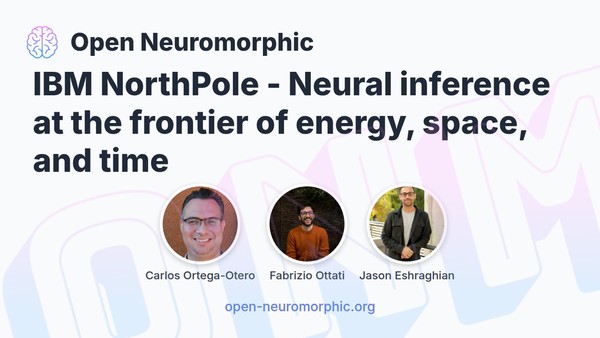
Carlos Ortega-Otero

Fabrizio Ottati

Jason Eshraghian
Upcoming Workshops
No workshops are currently scheduled. Check back soon for new events!
Are you an expert in a neuromorphic topic? We invite you to share your knowledge with our community.
Inspired? Share your work.
Share your expertise with the community by speaking at a workshop, student talk, or hacking hour. It’s a great way to get feedback and help others learn.