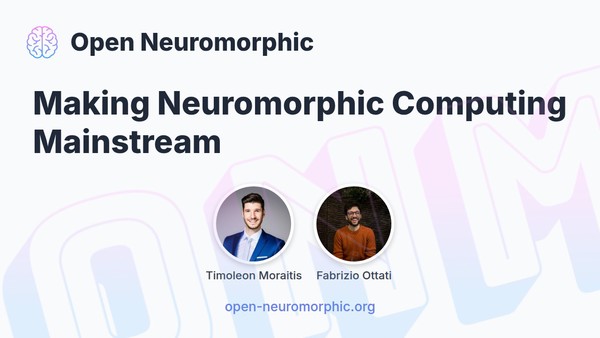
Neuromorphic computing frequently focuses on decreasing the energy consumption of AI through efficient, spiking approximations of conventional deep learning methods. However, as Dr. Timoleon Moraitis argues in this session, treating biological inspiration solely as a tool for energy efficiency limits the field. By instead identifying specific, unexploited biological mechanisms—like Hebbian plasticity and short-term synaptic dynamics—neuromorphic models can actually expand the capabilities of State-of-the-Art (SOTA) AI, yielding improvements in generalization, robustness, and learning speed.
Key Takeaways
- Approximating standard deep learning purely for energy efficiency inherently limits neuromorphic computing’s potential.
- SoftHebb uses localized Hebbian plasticity and Winner-Take-All competition to train deep networks without backpropagation.
- Networks trained with SoftHebb demonstrate striking natural resilience to adversarial attacks compared to standard backprop models.
- Implementing short-term plasticity optimally models dynamic environments, solving tasks historically out of reach for neuromorphic systems.
Workshop Format & Takeaways
The session explored the transition from theoretical neuroscience to practical machine learning applications. Moraitis detailed the “SoftHebb” algorithm, an unsupervised learning rule utilizing local Hebbian updates combined with soft Winner-Take-All inhibition. Because the algorithm relies entirely on local information, it bypasses the non-local weight-transport problem of backpropagation. As demonstrated, SoftHebb not only achieves high accuracy on image recognition tasks but also exhibits remarkable resilience to adversarial noise that easily fools standard models.
The presentation then transitioned into dynamic, temporal problems. By implementing short-term plasticity—where synapses elastically weaken or facilitate in response to recent activity—the network was able to effortlessly track targets through heavy occlusions in video data, outperforming standard LSTMs and CNNs. The workshop concluded by linking these algorithms directly to physical hardware, showing how memristive nanodevices can naturally physically encode these short-term and long-term plasticities using combinations of electrical fields and light.
What This Means for Neuromorphic Computing
To break into the mainstream, neuromorphic computing cannot merely offer a lower-power, lower-accuracy version of what GPUs already do. It must offer capabilities that conventional architectures struggle with. By demonstrating that localized, brain-inspired learning rules inherently protect against adversarial attacks and naturally parse temporal continuity without massive memory overhead, this research provides a compelling blueprint.
It proves that abandoning backpropagation in favor of biological mechanisms can result in algorithms that are not only energy-efficient but objectively superior for dynamic, real-world edge applications. When physical nanoscale hardware, such as memristors, can innately manifest these synaptic dynamics at the hardware level, the entire neuromorphic stack shifts from being an interesting simulation to an indispensable component of next-generation, high-performance artificial intelligence.
About the Speakers

Timoleon Moraitis

Fabrizio Ottati
Upcoming Workshops
No workshops are currently scheduled. Check back soon for new events!
Are you an expert in a neuromorphic topic? We invite you to share your knowledge with our community.
Inspired? Share your work.
Share your expertise with the community by speaking at a workshop, student talk, or hacking hour. It’s a great way to get feedback and help others learn.