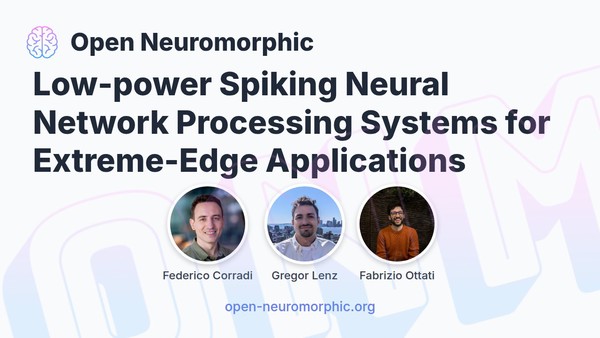
Delivering real-time, ultra-low-power artificial intelligence to the extreme edge remains one of the most pressing challenges in computing. While traditional Deep Neural Network (DNN) accelerators focus on minimizing memory access through novel architectures, true edge autonomy—such as insertable biomedical devices or always-on radar gesture recognition—demands micro-watt power budgets. Approaching this challenge through brain-inspired, event-driven Spiking Neural Networks (SNNs) requires rethinking both the silicon architecture and the algorithmic methods used to train them.
Key Takeaways
- The Microbrain Architecture: A synthesizable mixed-signal approach that marries the high fidelity and rapid iteration cycle of digital design flows with the extreme efficiency of asynchronous event-driven computation.
- Clockless, Self-Timed Neurons: By utilizing a unique multi-phase oscillator and an analog thyristor delay cell, neurons in the Microbrain space out incoming spikes to allow sufficient processing time without requiring a global power-hungry clock.
- Extreme-Edge Biomedical Monitoring: Paired with an asynchronous analog-to-spike converter, a 100-neuron Microbrain network achieved highly accurate, real-time temporal feature extraction on ECG data (PQRST wave detection) using under 50 microwatts of power.
- Forward Propagation Through Time (FPTT): Because traditional Backpropagation Through Time (BPTT) requires unrolling the network and caching states over thousands of micro-timesteps, memory requirements rapidly explode. FPTT optimizes an instantaneous risk function instead, dramatically reducing memory overhead.
Workshop Format & Takeaways
The workshop detailed the hardware-software codesign necessary for building extreme-edge intelligence. It began with an architectural deep dive into the Microbrain chip, explaining the specific transistor-level design of its analog delay cells. The session then showcased real-world benchmarks, comparing the system’s sub-millisecond latency against state-of-the-art synchronous DSPs in radar and ECG tasks. Finally, the presentation shifted to algorithmic scaling, demonstrating how the adoption of FPTT allowed the team to train a massive 6.2-million-neuron, 40-million-parameter SNN for complex RGB object detection.
What This Means for Neuromorphic Computing
This research proves that the gap between theoretical biological efficiency and practical silicon deployment can be bridged using hybrid approaches. Fully analog systems suffer from noise and high design times, while purely digital systems pay an enormous power penalty for von Neumann bottlenecks and rigid clock trees. By retaining a digital flow but replacing the global clock with localized, self-timed asynchronous event processing, systems can achieve the ultra-low-power requirements of implantable devices.
Furthermore, the successful application of Forward Propagation Through Time signals a crucial maturation for the field. The inability to train deep SNNs due to the memory constraints of unrolled timesteps has long been a barrier; overcoming this allows event-driven architectures to finally scale up to complex, multi-megapixel vision tasks that were previously the exclusive domain of traditional CNNs.
Resources
- Video Recording: xiYUVzdwDIA
About the Speakers

Federico Corradi

Gregor Lenz

Fabrizio Ottati
Upcoming Workshops
No workshops are currently scheduled. Check back soon for new events!
Are you an expert in a neuromorphic topic? We invite you to share your knowledge with our community.
Inspired? Share your work.
Share your expertise with the community by speaking at a workshop, student talk, or hacking hour. It’s a great way to get feedback and help others learn.