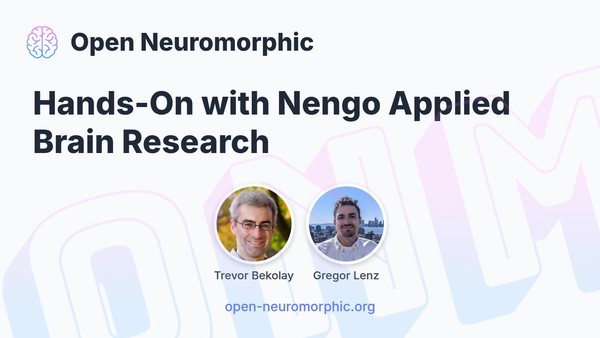
Nengo is a highly flexible neural simulator designed to build functional, large-scale brain models and deploy them to neuromorphic hardware. Rather than relying exclusively on backpropagation to train networks from scratch, Nengo utilizes the Neural Engineering Framework (NEF) to analytically compile high-level algorithms—such as motor control loops or dynamic oscillators—directly into spiking neural architectures. In this session, Trevor Bekolay walks through the core objects and architectural philosophy that allow Nengo to bridge cognitive modeling with practical robotics.
Key Takeaways
- Nengo strictly separates its front-end model definition from its back-end hardware compilation.
- The Neural Engineering Framework (NEF) represents mathematical vectors via the distributed activity of neural populations.
- Nodes allow arbitrary Python functions to route non-neural signals or external data directly into spiking networks.
- Nengo translates high-level functions (like multiplication or oscillators) by calculating optimal decoding weights.
Workshop Format & Takeaways
The session provided a deep dive into Nengo’s Python-based API, exploring the five core front-end objects: Ensembles, Nodes, Connections, Probes, and Networks. Bekolay demonstrated how Nengo’s strict separation of the front-end (model building) and the back-end (the simulator) allows the exact same Python script to be simulated locally on a CPU or mapped seamlessly onto specialized neuromorphic hardware like Intel’s Loihi.
The workshop illustrated the three core principles of the NEF: Representation, Transformation, and Dynamics. Instead of slowly learning connection weights through trial and error (as in traditional deep learning), Nengo analytically solves for the optimal decoding weights required to execute a specific mathematical function. The session concluded with live visualizations in the Nengo GUI, showing how recurrent connections can be explicitly configured to create sustained memory loops and cyclic oscillators directly out of spiking neurons.
What This Means for Neuromorphic Computing
A significant barrier in neuromorphic computing is the extreme difficulty of getting spiking neurons to perform precise, coordinated actions. Historically, engineers had to either painstakingly hand-tune network weights or rely on incredibly slow, resource-heavy training loops. Nengo offers a structural solution by providing a compiler that intrinsically understands the mathematics of neural representation.
This enables engineers to explicitly program robotic controllers, vision systems, and associative memories into neuromorphic substrates without relying on computationally expensive deep learning models. By marrying traditional control theory with spiking neural dynamics, the Nengo framework drastically accelerates the prototyping phase, allowing developers to swiftly deploy complex, low-power adaptive control loops onto physical robots and drones operating in the real world.
About the Speakers

Trevor Bekolay

Gregor Lenz
Upcoming Workshops
No workshops are currently scheduled. Check back soon for new events!
Are you an expert in a neuromorphic topic? We invite you to share your knowledge with our community.
Inspired? Share your work.
Share your expertise with the community by speaking at a workshop, student talk, or hacking hour. It’s a great way to get feedback and help others learn.