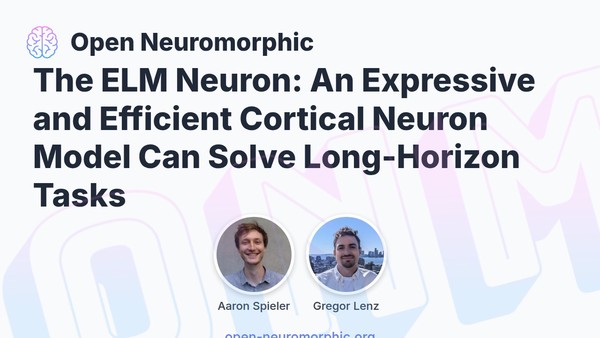
Biological cortical neurons are remarkably sophisticated computational devices, temporally integrating their vast synaptic input over an intricate dendritic tree, subject to complex, nonlinearly interacting internal biological processes. With the aim to explore the computational implications of leaky memory units and nonlinear dendritic processing, the Expressive Leaky Memory (ELM) neuron model was introduced as a biologically inspired phenomenological model of a cortical neuron. Remarkably, by exploiting a few slowly decaying memory-like hidden states and two-layered nonlinear integration of synaptic input, the ELM neuron can accurately match biophysical input-output relationships with under ten thousand trainable parameters.
Key Takeaways
- High-fidelity matching of biophysical models: The ELM neuron can accurately predict the spike timing and membrane voltage of highly detailed biophysical simulations using a fraction of the compute (reducing parameters from ~10 million in traditional models to under 10,000).
- Nonlinear dendritic processing: Unlike standard leaky integrate-and-fire (LIF) models that linearly sum inputs, the ELM neuron utilizes a small Multi-Layer Perceptron (MLP) within its recurrence, simulating the highly expressive, nonlinear integration found in actual dendritic trees.
- Solving the vanishing/exploding gradient problem: By explicitly designing the dynamics with configurable, slow-decay time scales and bounded growth constraints, the ELM architecture stably learns over extremely long contexts.
- Superior long-horizon performance: When evaluated on temporally demanding tasks like the Long Range Arena (LRA) and Spiking Heidelberg Digits (SHD-Adding), the model vastly outperforms traditional LSTMs and approaches or exceeds specialized sequence models.
Workshop Format & Takeaways
The session walked through the theoretical origins of the ELM neuron, contrasting computationally expensive biophysical models with efficient phenomenological models. Through detailed ablation studies, the workshop demonstrated exactly which biological features (e.g., memory units, explicit time scales, non-linear integration) are necessary to capture complex neural dynamics. It concluded with deep learning insights, proposing that bounded growth, controlled decay, and nonlinear processing are the three fundamental pillars required for Recurrent Neural Networks (RNNs) to learn complex dependencies over vast temporal horizons.
What This Means for Neuromorphic Computing
For decades, machine learning has utilized dramatically oversimplified models of biological neurons. The ELM neuron provides compelling evidence that the computational power of the brain stems not just from network-level connectivity, but from the immense expressive capacity of individual neurons.
By packing nonlinear processing into the recurrence of a single unit, ELM challenges the assumption that long-range dependencies require the immense memory bandwidth and parallel matrix multiplications of Transformers. As noted during the session, shifting the compute burden into highly complex, localized modules that communicate via sparse spikes offers a clear path toward extreme energy efficiency on future hardware, avoiding the interconnect bandwidth bottlenecks plaguing modern LLM inference.
Resources
- Video Recording: q0shX-zCk4c
About the Speakers

Aaron Spieler

Gregor Lenz
Upcoming Workshops
No workshops are currently scheduled. Check back soon for new events!
Are you an expert in a neuromorphic topic? We invite you to share your knowledge with our community.
Inspired? Share your work.
Share your expertise with the community by speaking at a workshop, student talk, or hacking hour. It’s a great way to get feedback and help others learn.