


Developing intuitive tools for event-based data requires balancing simple file conversions with the demands of complex filtering pipelines. This session explores the command-line interface (CLI) design for the Faery library, analyzing how established media tools like FFmpeg and GStreamer inform the creation of a seamless, UNIX-style pipeline for processing asynchronous neuromorphic data.
Key Takeaways
- Exploration of the ideal Command Line Interface (CLI) design for the Faery event processing library.
- Balancing the need for simple, IO-centric file conversions with the demands of complex, custom filtering pipelines.
- Identification of distinct user personas, ranging from exploratory data analysts to real-time systems engineers.
- Evaluation of Python’s
argparselimitations and strategies for parsing nested, pipeline-style command-line arguments.
What Was Built / Demonstrated
The demonstration focused on brainstorming and structuring the CLI for Faery to mirror a highly dynamic Python API. The team evaluated Python’s argparse limitations, debating strict input/output arguments versus a modular approach using delimiter characters (like !) to sequentially chain filters. The session mapped out specific workflows, ranging from rapid visual diagnostics—such as generating “wiggle plots” and MP4 renders—to headless streaming on embedded Raspberry Pi edge devices.
What This Means for Neuromorphic Computing
Accessible tooling is often the bottleneck for broader adoption of neuromorphic technologies. By designing Faery to be as ubiquitous and user-friendly as traditional computer vision and media tools (e.g., ImageMagick or FFmpeg), the barrier to entry for working with event cameras is significantly lowered.
Providing a robust, standalone CLI means researchers and engineers can integrate event-based data into existing bash scripts, headless Raspberry Pi setups, and automated data pipelines without needing to write complex Python code or manage virtual environments from scratch. Iterating on these API designs ensures the community gets robust infrastructure capable of handling the unique challenges of asynchronous neuromorphic data.
About the Speakers

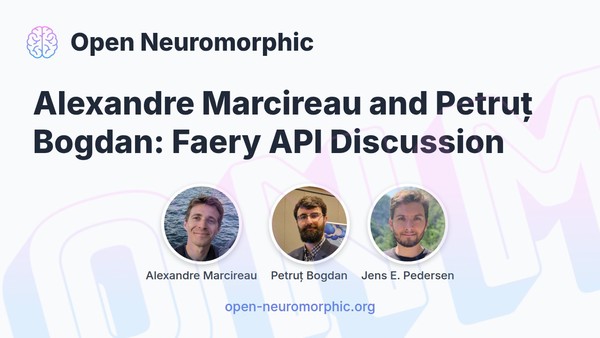
Alexandre Marcireau

Petruț Bogdan

Jens E. Pedersen
Next Hacking Hour
No Hacking Hours are currently scheduled. Check back soon for new events!
In the meantime, join our Discord to connect with the community and see what others are working on.
Inspired? Share your work.
Share your expertise with the community by speaking at a workshop, student talk, or hacking hour. It’s a great way to get feedback and help others learn.