

As Open Neuromorphic continues to grow as a central hub for researchers, students, and engineers, we are excited to announce the ratification of the 2026 Executive Committee.
Following our recent General Meeting, a new leadership team has been elected. This transition marks a pivotal moment for ONM’s governance: the incoming committee has been elected with a specific mandate to update the Organisational Charter.
While the new committee members currently hold the traditional titles required by our existing bylaws, their primary governance goal is to flatten the organizational structure. In the coming months, they will work to transition the EC from a hierarchical model to one defined by collaborative areas of responsibility.
Please join us in welcoming the new committee members.
The 2026 Executive Committee
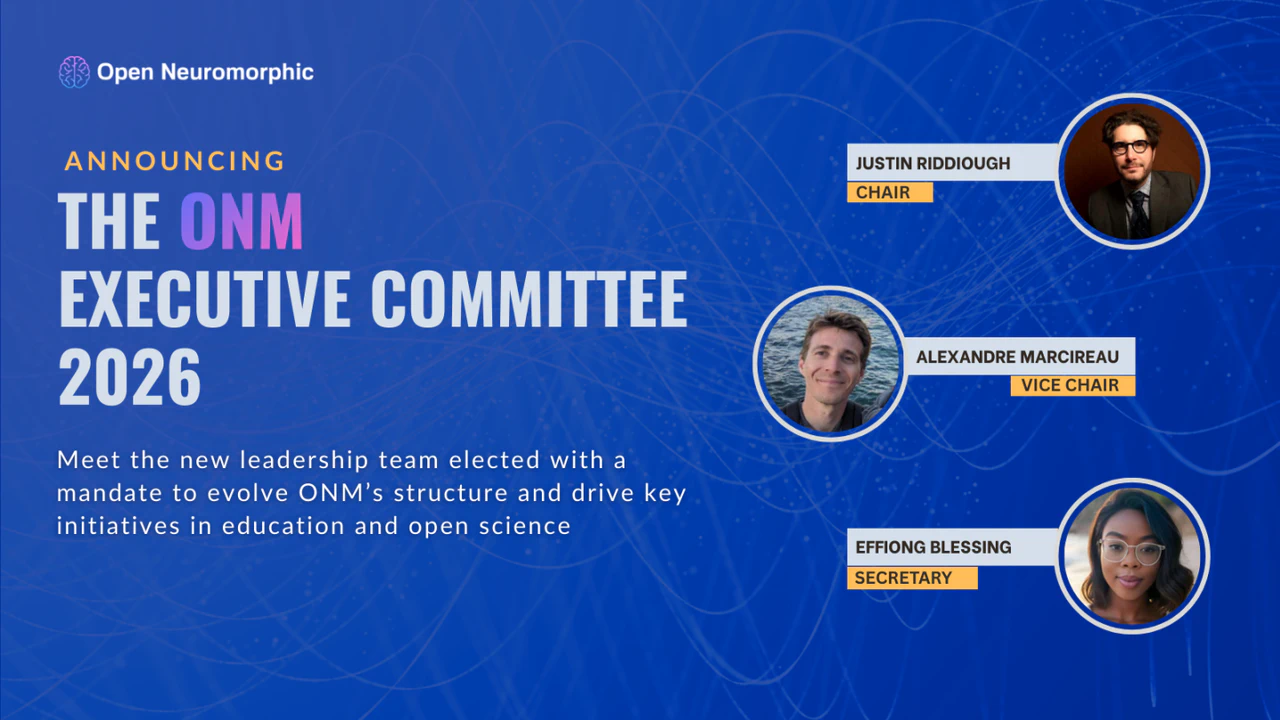
Chair: Justin Riddiough
Previously serving as Vice-Chair, Justin has been elected as the new Chair. He brings extensive experience in digital infrastructure and community operations. He plans to focus on ensuring the stability and scalability of ONM’s platforms, financial sustainability, and the “Knowledge Graph” strategy of the website.
“My goal is to provide a stable, open-source infrastructure that empowers our volunteers and researchers to build the future of neuromorphic computing without administrative friction.”
Vice-Chair: Alexandre Marcireau
Alexandre joins the committee as Vice-Chair. As a respected researcher in the event-based vision space, he will focus on scientific integrity and quality control. His aim is to ensure our initiatives align with academic rigor while bridging the gap between established research standards and open community growth.
“We need to balance inclusivity with scientific standards. I look forward to helping ONM become a credible, authoritative resource where open science can thrive.”
Secretary Chair: Effiong Blessing
Effiong Blessing is a PhD candidate in Computer Science specializing in neuromorphic computing and brain-inspired AI. Her work sits at the intersection of spiking neural networks, hybrid SNN-LLM architectures, energy-efficient AI systems and cross-modal neuromorphic systems. She co-leads Project PHASOR, a multi-institutional neuromorphic computing initiative, and is an active member of the NIH BRAIN Initiative NeuroAI community.
As Secretary Chair of Open Neuromorphic, she focuses on community engagement, educational pipelines, and competitions — including the upcoming Zero to Silicon series designed to take students from curiosity to contribution.
A Mandate for Evolution
The 2026 General Assembly discussed moving away from a traditional hierarchy to better reflect the collaborative nature of open source. The new committee is tasked with exploring these changes and drafting updates to the Charter. This shift aims to distribute decision-making among leaders with specific domain expertise rather than concentrating it in a single title.
A Note of Gratitude
We extend our deepest gratitude to the outgoing Chair, Jens E. Pedersen, and Secretary, Danny Rosen. Their vision and tireless effort over the past year established the foundational charter, policies, and volunteer infrastructure that allow us to operate today. They remain valued members of our Fellowship.
Looking Ahead: 2026 Priorities
The new committee has already begun work on several key initiatives discussed during the transition:
- Educational Pipelines: Developing the “Zero to Silicon” series and hybrid events to create clear on-ramps for undergraduates.
- Open Source Advocacy: Continuing to highlight open tools while encouraging proprietary groups to engage with the community transparently.
- Knowledge Retention: Exploring tools to better capture technical discussions in Discord, turning ephemeral chats into permanent resources.
- Community Competitions: Collaborating with partners like Project PHASOR to introduce benchmarking competitions that drive innovation.
Enjoy this content? Share it!
Sharing our articles and resources is one of the easiest and most effective ways to support Open Neuromorphic. It helps us reach a wider audience, grow our community, and continue our mission of advancing open-source neuromorphic computing. Your support is greatly appreciated!
About the Authors

Justin Riddiough

Alexandre Marcireau

Effiong Blessing
Have an idea? Share your voice.
Open Neuromorphic is a community-driven platform. We invite you to share your research, tutorials, or insights by writing a blog post.